Getting Started with manati
manati is a command line interface (CLI) for managing Python projects.
Create new Python projects with ready-to-go recommended project structure.
Add important files to existing projects
like setup.py, .gitignore, Sphinx documentation, choose a license and more.
Run test suites, analyze test coverage and deploy to PyPi.
Even manati is managed using manati… so meta.
Installation
pip install --upgrade manati
Usage
Creating a new project
manati create -n myproject
creates a complete Python project structure inside the current working directory:
myproject
├── docs
│   ├── Makefile
│   ├── conf.py
│   ├── index.rst
│   ├── make.bat
│   └── requirements.txt
├── myproject
│   ├── __init__.py
│   └── main.py
├── LICENSE
├── README.md
├── setup.py
├── .gitignore
└── tests
    └── test_main.py
including sample source,
tests, documentation, setup.py, local git repository and a
suitable .gitignore file.
After creation, the project is already installed in development (editable) mode, so you can start coding right away.
Adding stuff to an existing project
Sometimes you have an existing project, but initially you did not choose a license,
or your .gitignore is missing. You can add those special files with the manati add command.
Add a license
manati add license
where you have the choice between standard license texts like MIT, GPLv3, Apache, …
Add a .gitignore file
manati add gitignore
The created .gitignore contains all usual patterns that should typically be ignored
by git in Python projects.
Add a setup.py file
manati add setup.py
Add a project documentation folder
manati add docs
makes a ./docs folder and sets up a Sphinx-based documentation in Read-The-Docs-style:
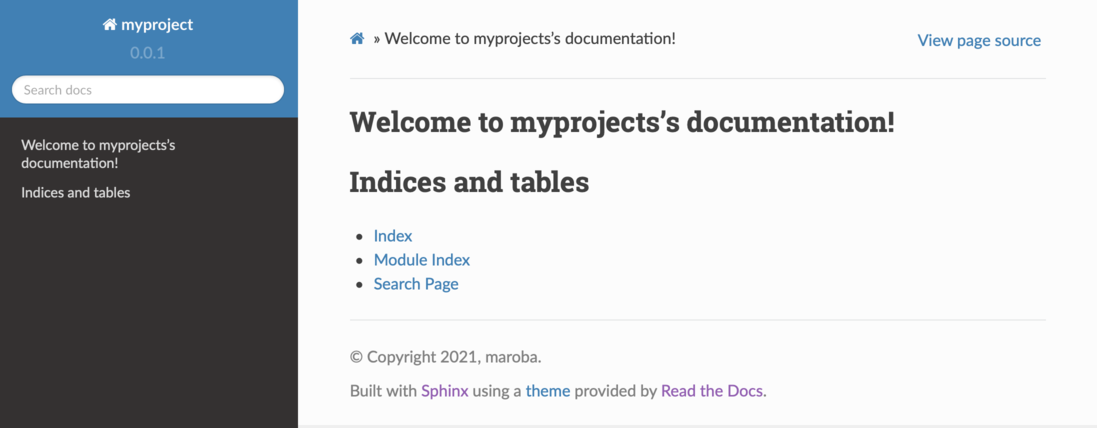 generated docs
Call manati add --help for more information.
Add github actions
Add a standard github action which automatically runs build and tests on the github CI/CD systems whenever you push a commit:
manati add github-action
Run stuff
Run tests
manati run tests
Analyze test coverage
manati run coverage
Re-Build docs and show it browser
manati run docs
Run PEP8 style analyzer
manati run flake8
Deploy your project
To PyPi
manati deploy pypi
After that anyone in the world can install your package using pip.
As a prerequisite for deployment, you need an account at PyPi.
To Github, Gitlab, etc.
Create an empty repository at the platform of your choice, like github, and deploy your local project repository there, e.g.:
manati deploy repo
After that your local repo is in sync the remote one.
Note for Windows users
Depending on your environment settings, you may have to use manati by prepending python -m or py -m like in
python -m manati create